Key takeaways
- The public GitHub mirror hands you the complete PDF plus notebooks, no signup.
- It has not changed since 21 September 2025, so the free path is also the stale one.
- The publisher's own page gives a subscription preview, not a file.
- The ranking documents count differently: 21 chapters in the book, then 12, 6 and 5 patterns.
Search "agentic design patterns pdf" and you get a maze. The same maze shows up for "agentic ai design patterns pdf", "ai agent design patterns pdf", "google ai agent design patterns pdf" and "designing autonomous agents pdf": two GitHub mirrors, a publisher record, an academic preprint, a practitioner guide, a document host, and a landing page that wants your email. They all look like the same thing. They are not.
Here is the short version. One path gives you a file with nothing in the way. Three intercept you first. And the pattern counts you collect along the way do not agree with each other, because they are answering different questions.
Where each agentic design patterns pdf link takes you
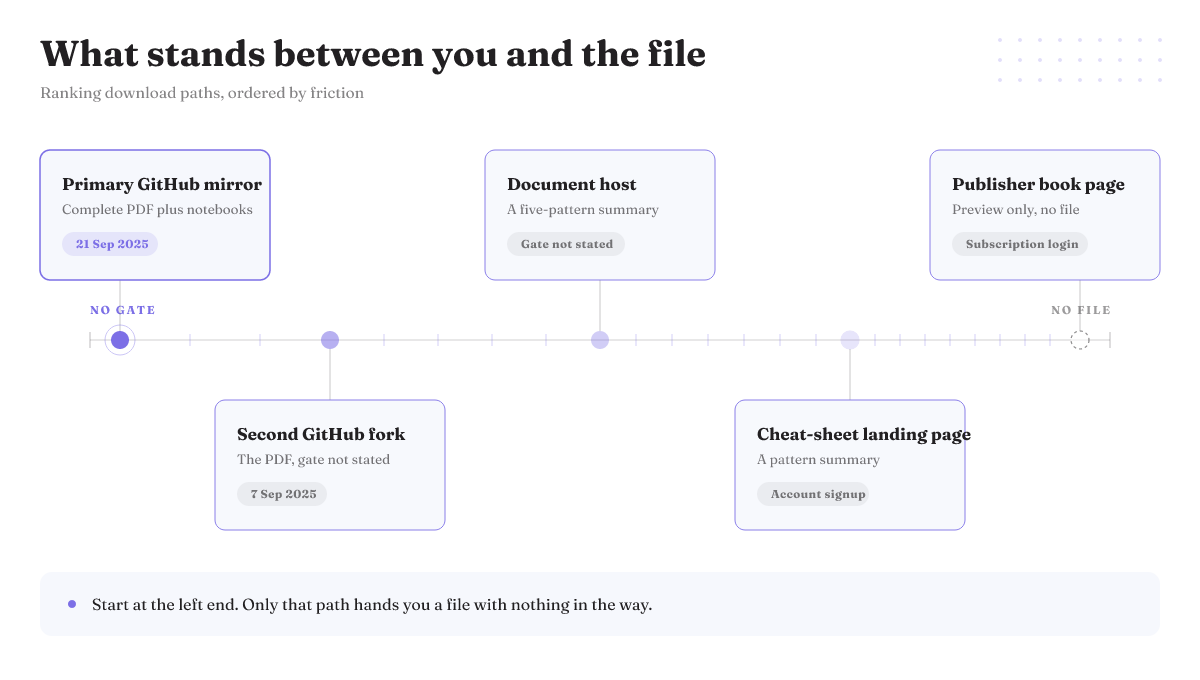
The evoiz repository holds the complete PDF of Antonio Gulli's Agentic Design Patterns: A Hands-On Guide to Building Intelligent Systems, along with per-chapter code notebooks. It carries 1.8k stars and 340 forks. The PDF was added on 21 September 2025 and has sat there since.
That is the answer to the literal query. Everything below is what the ranking pages do not tell you.
| Path | What you receive | Gate | File date |
|---|---|---|---|
| Primary GitHub mirror | Complete PDF plus notebooks | None | 21 Sep 2025 |
| Second GitHub fork | The PDF | Not stated | 7 Sep 2025 |
| Publisher book page | Preview only | Subscription or institutional login | Not applicable |
| Cheat-sheet landing page | A pattern summary | Account signup | Not stated |
| Document host | A five-pattern summary | Not stated | Not stated |
| arXiv preprint | A different paper, not the book | None | 27 Jan 2026 |
Two things about this table. First, the second fork is staler. Its file has not been touched since 7 September 2025, two weeks behind the primary mirror. Two results sit side by side on one query holding files of different vintages, and neither page says so. What that fork publishes is a file listing and a date, so the row stops there: it does not say what else comes with the PDF or what stands between you and it.
Second, this is a snapshot with a date on it, not a permanent map. Gate behaviour changes without notice and mirrors can be taken private, so three of these rows carry no gate value or no file date and the columns are only as good as the day they were read. Check them yourself before you build anything on them.
The free file and the book you can buy are described differently
Most readers assume the mirrored PDF is the book. The two artifacts are described in numbers that do not line up.
The mirror describes its material as 21 chapters plus 7 appendices. The publisher's catalogue record for the commercial edition lists XLIII plus 427 pages, and its page delivers only a preview of subscription content rather than the file.
Those are two descriptions from two sources. They are not a page-by-page diff. Which chapters actually differ, if any do, is not something the published records let anyone state, and this page will not pretend otherwise. What you can safely conclude is narrower and more useful: do not cite the free file as if it were the edition of record, and do not assume a chapter you read in one exists in the other.
Why one query returns four different catalogue sizes
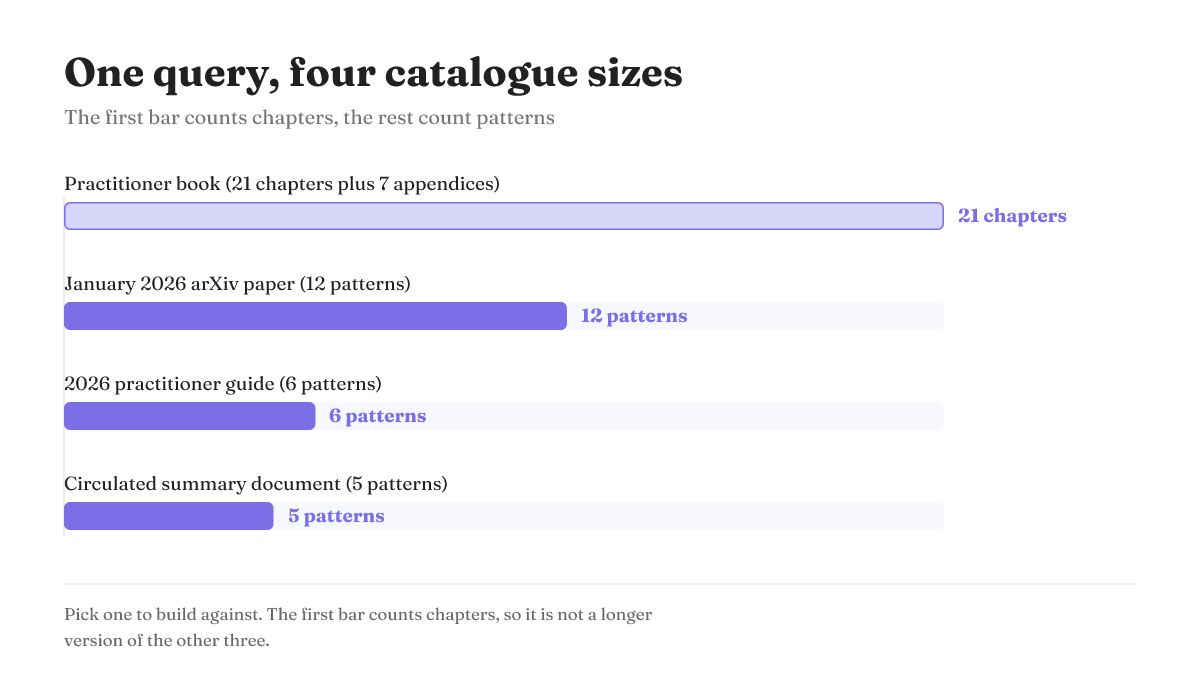
You download two documents, count what is in them, and the numbers do not match. Nothing is broken. You have collected rival taxonomies, not four sizes of one list.
| Document | Count | Category scheme |
|---|---|---|
| The practitioner book | 21 chapters plus 7 appendices | Chapter-by-chapter catalogue |
| January 2026 arXiv paper | 12 patterns | Foundational; Cognitive and Decisional; Execution and Interaction; Adaptive and Learning |
| 2026 practitioner guide | 6 patterns | Reflection, Tool Use, Planning, Multi-Agent Collaboration, Orchestrator-Worker, Evaluator-Optimizer |
| Circulated summary document | 5 patterns | Reflection, Tool Use, ReAct, Planning, Multi-Agent |
Note the units in the first row. The book is catalogued in chapters, not in a numbered pattern count, so it is not a 21-pattern list sitting next to a 12-pattern one. That alone explains part of the confusion readers arrive with.
The arXiv paper groups its twelve under four categories. The SitePoint guide runs Reflection through Evaluator-Optimizer and pairs the six with a selection decision tree and a production-considerations section. The circulated document stops at five.
An honest limit: a true cell-by-cell crosswalk needs every catalogue's named pattern list. The arXiv twelve are published as category names and a count. So this reconciles the schemes, not each individual pattern.
The academic argument that these catalogues are ad hoc
The strongest published objection to all of the above arrived on 27 January 2026.
The paper's charge is direct. Existing efforts to characterise agentic design patterns "often lack a rigorous systems-theoretic foundation, resulting in high-level or convenience-based taxonomies that are difficult to implement." Its counter-proposal deconstructs an agentic AI system into five core interacting functional subsystems, then derives patterns from that structure rather than from what practitioners happen to have named.
It is not an anonymous swipe. The author list runs through University College Cork, Vietnam National University, IBM Research Ireland and Trinity College Dublin, presented in the LAW 2025 workshop track. That is an academic provenance distinct from the books and mirrors ranking beside it.
Take it for what it is. Read as an ai agent architecture patterns pdf rather than a technique list, it is the closest thing on this query, and it is still a workshop paper proposing a rival framework rather than a settled replacement. It also answers a different question than the one that brought you here: you came for a file, and it is offering a theory of how the field should be organised.
Was the book written by AI?
Readers keep asking. The claim circulates that the book is machine-written.
What the published record documents is narrow. The front matter states that the cover image is AI-generated. That is a documented fact about the cover, not about the text.
So the honest answer has a boundary in it. The circulating accusation goes far past a cover image, and the published documents do not settle it either way. The question is open. Anyone telling you it is closed, in either direction, is going past what the record supports, and this page is not going to close it for you.
One related fact worth having: the author's royalties are donated to Save the Children, which the free distribution points to as its legitimacy signal.
What the file is good for once you have it
The book's premise is stated plainly in its own front matter. Just as design patterns changed software engineering by supplying a common language and reusable solutions to recurring problems, agentic patterns are meant to do the same for agent systems. Whether that holds is the argument the arXiv paper is having. But it tells you what the material is trying to be: a vocabulary, not a benchmark.
The code is framework-agnostic. Examples run across LangChain, Crew AI and Google ADK rather than committing to one stack. That is the right call for a reference text and it carries a cost. Framework-agnostic examples age at three different rates, and these notebooks sit on a file that has not moved since 21 September 2025.
If you want a selection aid rather than breadth, the six-pattern guide ships a decision tree and production notes alongside its six patterns.
There is also a mapping worth carrying in your head, whatever catalogue you pick. Most of these patterns have a classical software-engineering twin. Prompt chaining is pipe-and-filter. Reflection is a test-driven loop. Multi-agent collaboration is microservices with all the same coordination costs. Reading the catalogue that way turns a list of novel-sounding names into something you already know how to reason about, including where it fails.
Which catalogue to build against
Do not collect all four. Pick by the question you are actually asking.
You want to choose a technique for a specific job. Use the six-pattern guide. It ships a pattern-selection decision tree and a production-considerations section, which is the shape of the problem when you are choosing rather than surveying.
You want breadth and runnable code. Use the book from the GitHub mirror. It covers 21 chapters plus 7 appendices and hands you per-chapter notebooks alongside the text. It is the build agentic ai systems pdf on this query: code you can run, not a theory of how the field should be organised.
Multi-agent is the part you care about. Every multi agent design patterns pdf on this query carries an entry for it, so the count is not what decides it. The six-pattern guide splits the territory into Multi-Agent Collaboration and Orchestrator-Worker, while the five-pattern list keeps Multi-Agent as one item. The split is the more useful cut when the real question is who assigns work to whom.
You are arguing about system structure, not picking a technique. Use the arXiv framework. Its five-subsystem decomposition is built to reason about how the parts of an agentic system interact, which is a different job than naming a technique.
You want the shortest orientation. The five-pattern list covers Reflection, Tool Use, ReAct, Planning and Multi-Agent, and stops there.
This is a judgment about which document answers which question, built from what each one publishes about itself. It is not a benchmark. No run data sits behind it, so treat it as a routing rule rather than a ranking, and I am not going to dress it up as more than it is.
What this page cannot tell you
Three questions readers ask that the published record does not answer.
The licensing and redistribution status of the freely mirrored PDF. People ask whether downloading or re-hosting it is permitted. Nothing in the published record addresses it, so nothing here should be read as saying it is.
Whether the mirrored chapters match the published edition line by line. Only the counts are public: 21 chapters plus 7 appendices on one side, XLIII plus 427 pages on the other. A chapter-level table of contents for both would settle it. Neither is published.
Which patterns hold up under sustained production load. That needs run data over a stated window, and I do not have it. It is the question I most want answered and the one I am least willing to guess at.
If pattern choice is an operating decision for you rather than a reading list, the harness-engineering essays on building agentic AI systems are where that argument continues, alongside notes on agent orchestration tools, autonomous AI agents, and agentic engineering versus vibe coding.