Key takeaways
- MCP Toolbox for Databases is real: open-source, at v1.0, roughly 16,000 stars, actively maintained.
- The live question isn't whether it works. It's whether to standardize on it.
- Standardize only when your store and agent count make the layer earn its cost.
- Run the operational and security checks before production, not after.
Search "mcp toolbox for databases" and the whole first page of results belongs to one company. Google's repo, Google's launch post, Google's docs, Google's codelab. Every result teaches the same happy path: expose a dataset, connect an IDE, watch an agent run a query. That is useful, right up until you hit the question none of them answer. Should you adopt this layer at all?
That is the decision this page is about. Not whether the tool is good. It is a maintained, well-scaled, v1.0 open-source project. The harder call is when standardizing every agent on one database framework earns its complexity, and when you are better off with per-database or direct access. Nobody selling you the tutorial has a reason to make that call for you.
What MCP Toolbox actually is, and where it stands
At its core, MCP Toolbox is an open-source Model Context Protocol server that connects AI agents, IDEs, and applications directly to enterprise databases. It sits between the agent and the store, so the agent asks for a tool instead of holding raw database credentials.
The momentum is real. The repository carries roughly 16,000 stars, about 1,600 forks, and more than 2,000 commits, with a fresh commit landing the same day I checked. In April 2026 it reached v1.0, announced by a Google staff engineer, built around a strict split between the agent's reasoning and the actual system execution. Around the same time, MCP itself joined the Agentic AI Foundation under the Linux Foundation. So the standard is no longer a single vendor's side project.
Read those numbers for what they are. Stars and commit velocity tell you a project is alive and worked on. They do not tell you it fits your workload. A tool can be at v1.0 and still be the wrong shape for a one-database team.
The real call on MCP Toolbox for Databases: standardize, per-database, or hand-roll
Here is the sharpest line in the whole debate, and it does not come from Google. MCP is powerful where your users genuinely need structured tool access, and expensive over-engineering where they don't. The cost, complexity, and risk it adds do not show up in the demo. They surface once you move past the proof of concept.
That reframes the choice into three real options.
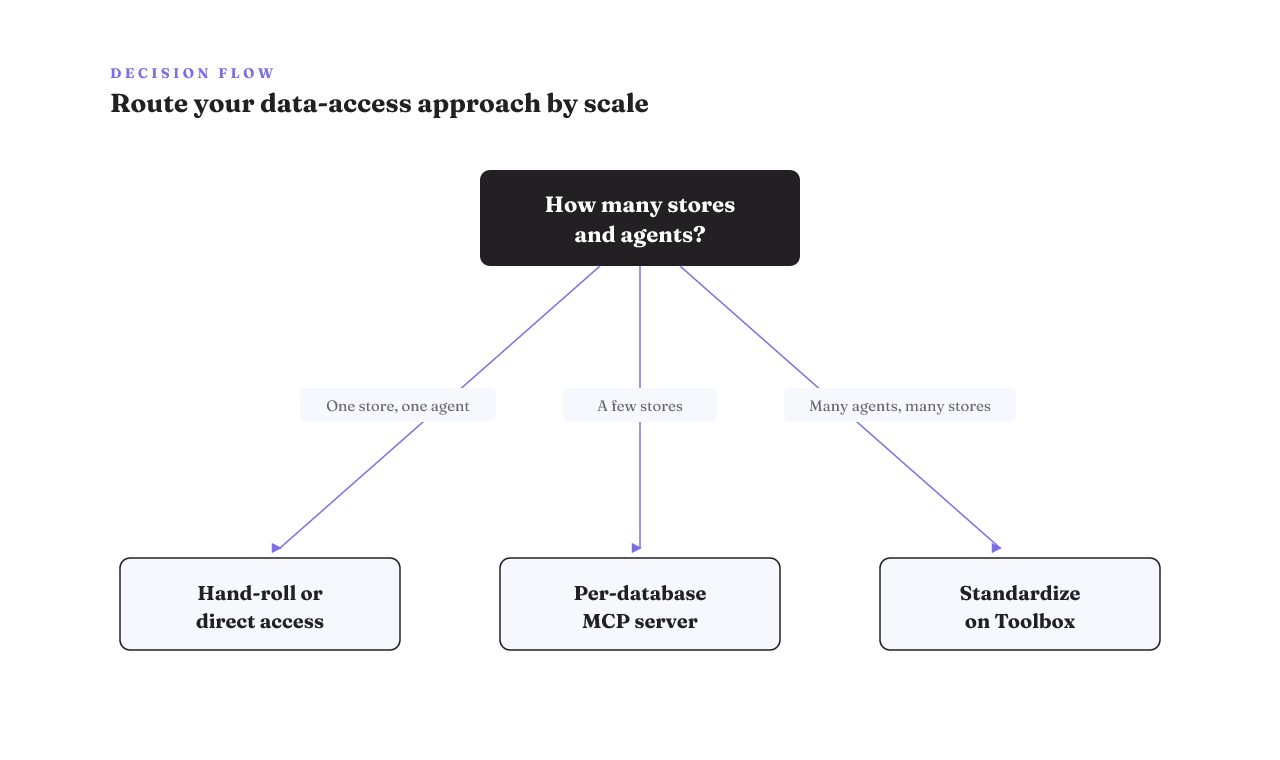
Hand-roll or direct access. One agent, one database, a handful of queries. You are almost never going to justify a standardized MCP layer here. A parameterized query and a scoped credential do the job with less to maintain.
Per-database MCP server. A few stores, a few agents, but each connector has its own quirks. You wire and vet each one by hand. This buys you the MCP interface without betting your whole stack on one framework, at the cost of maintaining several small things.
Standardize on Toolbox. Many agents reaching many stores, and you are tired of paying a per-connector vetting tax every time. This is where a single maintained framework starts to pay for itself. One tool surface, one thing to patch, one place to reason about access.
The break-even is not a number I can hand you. It moves with how many stores and agents you actually run. But the direction is clear: the more your fleet fans out, the more the shared layer earns its keep, and the harder it is to justify below a couple of stores and one agent.
What it connects to, and what to verify yourself
At the identity level, Toolbox connects agents, IDEs, and applications to enterprise databases. That is the claim the primary source supports, and it is the level I will assert.
What it does not do is let me hand you a settled roster. The exact list of supported databases, the current IDE integrations, and any version-specific coverage change fast, and they live in one place: the official repo and docs. So if you are searching "BigQuery MCP Toolbox" or "MCP Toolbox postgres" because that is your store, do not take a blog's word for it, mine included. Open the repository, read the current supported-source list, and confirm your database and your IDE are on it before you commit an architecture to it.
The same holds for the fast-moving edges. If you are looking for whether a newer IDE like Antigravity is wired in, that support surface is exactly the kind of thing that ships between releases. Check the repo's current state rather than a cached tutorial.
Where to actually get it, read the docs, and check the code
You do not need a lead-gen page to find this. The GitHub repository is the front door: the code, the release tags, the issues, and the documentation all live with it. That is where "mcp toolbox for databases documentation" and "mcp toolbox for databases github" both point, and it is the version of truth I would trust over any secondary write-up for what the tool supports today.
Two habits save you here. Read the release notes, not a listicle, for what version you are on and what changed. And read the open issues before you standardize, because that is where the real failure reports live, unpolished. A repo this active will tell you more in its issue tracker than any launch post will.
The failure modes the tutorials skip
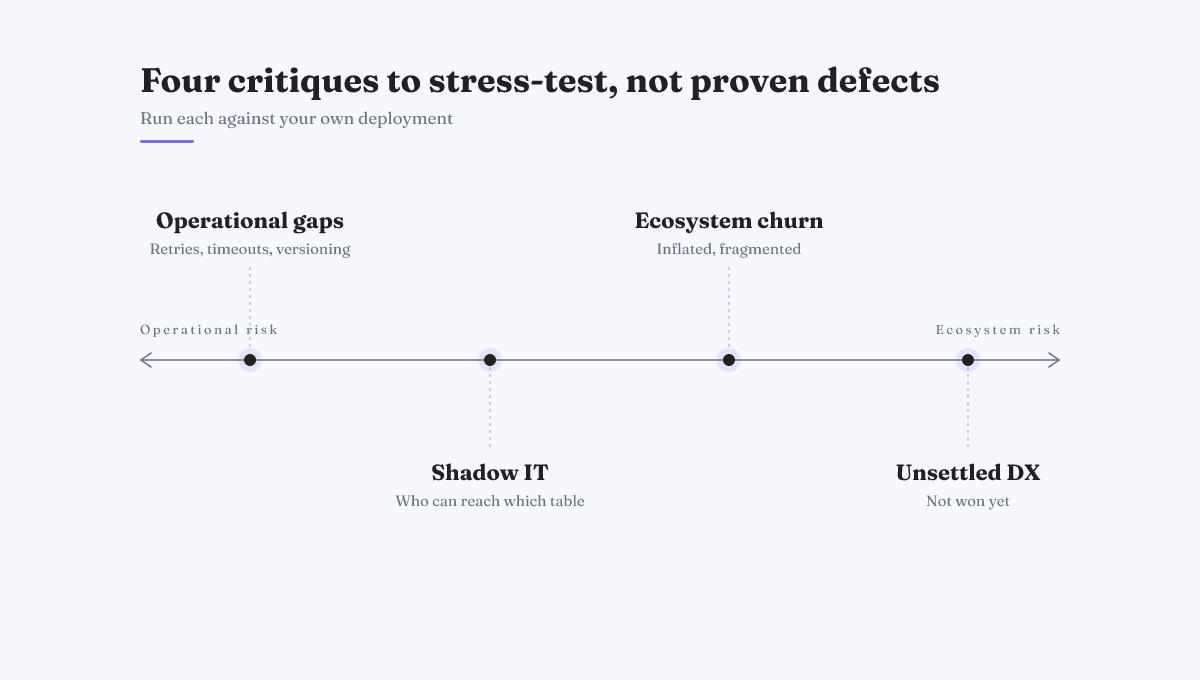
The word "production-quality" gets repeated across the first-party material like a settled fact. It is vendor framing, not an independent stress test. Four critiques from outside Google are worth holding against it before you ship.
The first is operational depth. An experienced practitioner argues that MCP overlooks four decades of hard-won distributed-systems lessons, leaving deployments missing capabilities that production remote-procedure-call systems have treated as essential since 1982. That is a strong opinion, and it is more than a year old now, so weigh it as a lens rather than a verdict. But it points at the right things to test: retries, timeouts, versioning, backpressure. Confirm your setup handles them.
The second is visibility. Security researchers describe MCP servers as an emerging shadow-IT surface, where most organizations have zero read on where those servers run, what they expose, or how they can be abused. A standardized data layer is only safe if someone can say, at any moment, which agent can reach which table. If you cannot answer that, you have not deployed a framework, you have deployed a blind spot.
These are critiques of MCP broadly, not proven defects in Toolbox itself. Treat them as a checklist to run against your own deployment, not as a reason to walk away.
Is MCP settled? Not yet
Adopting a standard is also a bet on its durability, so weigh the ecosystem, not just today's capability.
A recognized agents author makes the plain point that MCP's dominance is not yet settled, and that its current limits, especially developer experience, deserve scrutiny under all the hype. It is a short, opinionated read, so take it as one informed view. It lines up, though, with harder measurement. An empirical study of the MCP ecosystem asks whether the marketplaces are genuinely growing or inflated by placeholders and abandoned prototypes, whether servers are secure or expose systemic risk, and whether clients are converging on the protocol or staying fragmented. Its answers lean uncertain on all three, and it is a preprint, so read it as a careful question mark rather than a closed case.
The honest read: the standard is real and gaining, and the ecosystem around it is not finished settling. That is a fine reason to adopt a maintained, first-party server. It is also a reason to keep your data layer swappable.
The checks to run before you commit
This checklist is synthesized from public critiques, not a benchmark I ran. Validate each item against your own environment.
- Count first. How many stores and how many agents actually need this? One and one rarely justifies the layer. If the number is small, revisit direct or per-database access before you standardize.
- Map the blast radius. For every agent, write down which databases and which tables it can reach. If you cannot produce that map, you have a shadow-IT problem waiting, not a framework.
- Test the operational floor. Push retries, timeouts, and a version bump through your setup on purpose. The gaps the RPC critique warns about show up here, not in the demo.
- Read the issues, not the launch post. Standardize on what the repository actually reports today, and pin yourself to a known release rather than a moving target.
- Keep it reversible. Assume the ecosystem is still shifting. Choose the setup you could unwind in a week if the standard moves under you.
Where this fits a controllable agent harness
Every item on that list is really one question. When an agent can reach your database, who decides what it is allowed to do with that reach?
A standardized data layer is only as safe as the control around it. v1.0 and a clean reasoning-versus-execution split give you a good connector. They do not, on their own, make an agent's actions legible, steerable, and reversible. That control layer is the harness, and it is the problem Rifty works on: keeping agent actions reversible by default, so nothing irreversible ships without an operator's sign-off. It is the same lens behind how we think about framework choice, wiring up MCP servers, and guardrails on what an agent can execute.
Be clear on what Rifty is not. It is not a connector product, and it is by introduction only. If you just need to give one agent database access this week, adopt Toolbox from its repo and skip the rest of this. If you are wiring many agents into many stores and the thing keeping you up is control, that is the harder problem, and the one worth reading about next.