Key takeaways
- "TikTok MCP" is really three different tools sharing one name.
- Run ad campaigns: the official TikTok for Business Ads MCP.
- Analyze video virality: the community Seym0n/TikNeuron connector.
- Pull public data: a third-party data-extraction MCP.
- The official server is newest and moving fast, so specifics can shift.
You searched TikTok MCP expecting one thing to install. Page one hands you at least three. One runs ad campaigns. One scores video virality. One scrapes public data. They share a name and solve different jobs, and no result tells you which is yours. This guide splits TikTok MCP into three families, routes you by the job you actually have, then gives you the scope, auth, and terms that decide the call.
Which TikTok MCP for your job
Start from the job, not the search rank. Find your row, and you have your answer.
| Your job | Family | Connects to | Official? | Read vs write | Data scope | Auth | Verdict |
|---|---|---|---|---|---|---|---|
| Run and manage ad campaigns | Official for-Business Ads MCP | TikTok Ads platform | Yes, from TikTok | Read and write actions | Your account and ads data | Business Center account | Automating campaigns |
| Analyze videos and virality | Community Seym0n / TikNeuron connector | TikTok content via TikNeuron | No, community | Read for analysis | Public video details and subtitles | TikNeuron service | Content and virality research |
| Pull public data at scale | Third-party data-extraction MCP | Public TikTok pages | No, third party | Read to extract | Public videos, profiles, hashtags, trends, comments | Vendor API key | Building public datasets |
One caveat before you commit. A cross-platform advertising MCP, the kind that connects one agent to several ad platforms at once, solves a different problem than any single TikTok server. So the real question is whether you need TikTok depth or one connector spread across platforms. If it is depth, keep reading. If it is breadth, a single-platform TikTok MCP is the wrong tool.
One name, three different products
Here is why the same query returns unrelated tools. The official server is a standardized bridge built on the Model Context Protocol that connects AI agents to the TikTok Ads platform. The Seym0n connector reads video details and subtitles to gauge whether a post will go viral. The data-extraction option returns public profile and engagement data as structured output. Three jobs, one label.
The naming is genuinely muddled. If you picked the wrong one once and only found out mid-setup, you were not being careless. The market shipped three things under one name inside a single year, and the search results have not caught up. So slow down at the first step: name your job before you trust the top hit.
The official TikTok for Business Ads MCP
This is the "tiktok ads mcp" most people mean when they search for a tiktok mcp server to run campaigns. On May 13, 2026, TikTok opened its ads platform to AI agents with a new Model Context Protocol server and developer toolkit built to automate campaign work. Around June 30, TikTok extended it into an Agentic Hub, a marketplace built on the same for-Business MCP that connects agents to an advertiser's daily tools to create and manage campaigns. The scope is framed as the full campaign lifecycle, not a single read call.
It fits into a clear pattern. In 2026, Google, Meta, and TikTok each shipped a platform-official ads MCP server inside a roughly three-month window, all vendor-blessed and OAuth-native, and all distinct from the community connectors that came before.
One honest limit. The exact tool list and write scope for TikTok's server come from trade reporting, not confirmed from TikTok's own primary docs. Treat the specifics as approximate. What is clear is the shape: it is tied to Business Center accounts and enterprise terms, and it is the newest and fastest-moving of the three families.
The community connector on GitHub (Seym0n / TikNeuron)
If your job is analyzing content, the answer to "tiktok mcp github" is the Seym0n/tiktok-mcp project. It integrates TikTok access into Claude and other apps through a service called TikNeuron, and it is built to analyze TikTok videos to judge virality. That is a research job, not a campaign job. You point it at videos and pull subtitles, post details, and search results into your client.
Two things to know before you lean on it. It is unofficial and community-maintained, not vendor-blessed, and it depends on TikNeuron to work. The current release, exact setup steps, and governance are not settled from the repository in the sources here, so treat this as a capability rather than a pinned version. Open the repo and confirm the latest before you build on it. When it fits, a community connector is a fast way to get content analysis into your agent.
Data-extraction MCPs and where the TikTok API fits
The third family is a data-extraction tool, and it is where the "tiktok api" question lands. This kind of MCP extracts public TikTok data only: videos, profiles, hashtags, trends, and comments. It never touches private or login-required content. The flow is simple. You send a TikTok URL and get clean structured JSON back, with the proxies, CAPTCHAs, and parsing handled for you.
Be clear about what this is not. It is not an ad-management connector, so it will not launch or edit campaigns. It is not the official TikTok API either, and it is not the official for-Business server. It is a scraper for public data. If your job is building a dataset of public videos or engagement metrics, this is your row. If your job is spending ad budget, it is not.
How TikTok's scope compares to Meta, Google, Instagram, and YouTube
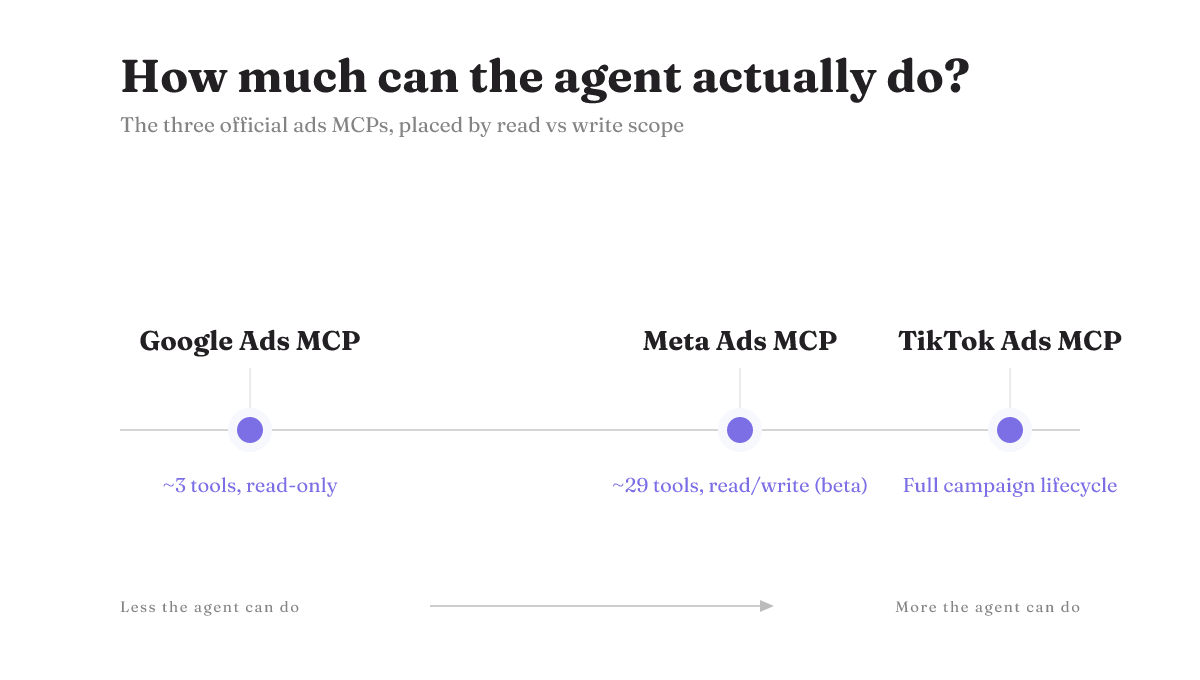
TikTok did not ship in isolation, and seeing the field explains its choices. Among the official ad-platform servers, scope varies sharply. Meta's MCP exposes roughly 29 read and write tools in open beta. Google's exposes roughly 3, read-only by design. TikTok's covers the full campaign lifecycle. So the answer to "how much can the agent actually do" is not the same across platforms, even when all three are official.
This maps the sibling searches too. A meta mcp query for Facebook and Instagram ad buying routes to Meta's server, since Instagram ad campaigns run inside Meta's platform. So an instagram mcp for paid work is usually the Meta server, not a standalone tool. For mcp youtube campaign work, the path runs through Google's ads MCP, since YouTube ads sit inside Google Ads. A dedicated Instagram MCP or YouTube MCP for organic content is less settled than these official ad servers, so treat those as moving targets and check the vendor's current docs.
Two cautions hold across the field. "Official" does not yet mean mature or read/write everywhere, and those tool counts trace to secondary reporting, not primary docs. Read them as direction, not a fixed spec.
Why read vs write is the line that matters most
Under all the naming, one axis decides the most: can the agent only read, or can it also act? A read-only server answers questions. A read/write server spends money and changes live campaigns. Google's read-only design is a deliberate guardrail, not a gap. TikTok's full-lifecycle framing points the other way, toward an agent that acts. Before you connect anything, decide how much you want the agent to do on its own, then pick the server whose scope matches that appetite. This is the harness-engineering read: control is a feature, and read-only is sometimes the mature choice.
The compliance layer the top results skip
Here is the part the commodity results leave out. If you connect a business agent to TikTok's ads data, you are inside TikTok's Business Products (Data) Terms, effective 22 January 2026. These govern any Business Products Data you share with TikTok or authorize it to access through its business products. So this is not just a setup question. It is a terms question you should answer before wiring an agent in.
Two limits to keep honest. This covers the business and ads path specifically, and it is not legal advice. The community connector and the scraper raise separate platform-terms questions of their own. You still have to check those before you run them.
How you wire your chosen server to Claude or your client
The "tiktok mcp claude" question has a clean answer once you know what MCP does. An MCP server exposes a data source in a format an AI client can read and act on. Because the protocol is open, a single server is not locked to one assistant. The same server works across clients like Claude, ChatGPT, Cursor, VS Code, and Windsurf. That is the whole point of the standard: build the connector once, reach many clients. The Seym0n connector, for one, is built to drop into Claude and other apps this way.
The step-by-step auth and setup differ by family, and they are not fully pinned from primary docs here. So point at each vendor's own setup rather than a generic recipe. If you are adding your first server to Claude, our guide to adding an MCP server to Claude walks the mechanics, and our notes on GitHub MCP servers cover what to check before you trust a community repo.
What is still moving, and when to re-check
Treat this whole field as a fast-moving target. As of mid-2026, only a few official ad-platform MCPs are usable without joining an alpha or waitlist, and fewer still offer meaningful campaign writes. So "official" is a starting line, not a finish. Any version, tool count, or availability here can change month to month.
Before you build on your pick, do three things. Confirm the tool scope against the vendor's current docs. Confirm which auth model and account type it needs. Confirm the terms that govern the data path you chose. The same choose-by-your-job frame applies well beyond TikTok. If you are weighing the paid-social side, our breakdown of the Facebook and Meta ads MCP runs the same routing logic across that platform. Pick by the job, check the scope and terms, then wire it in.